
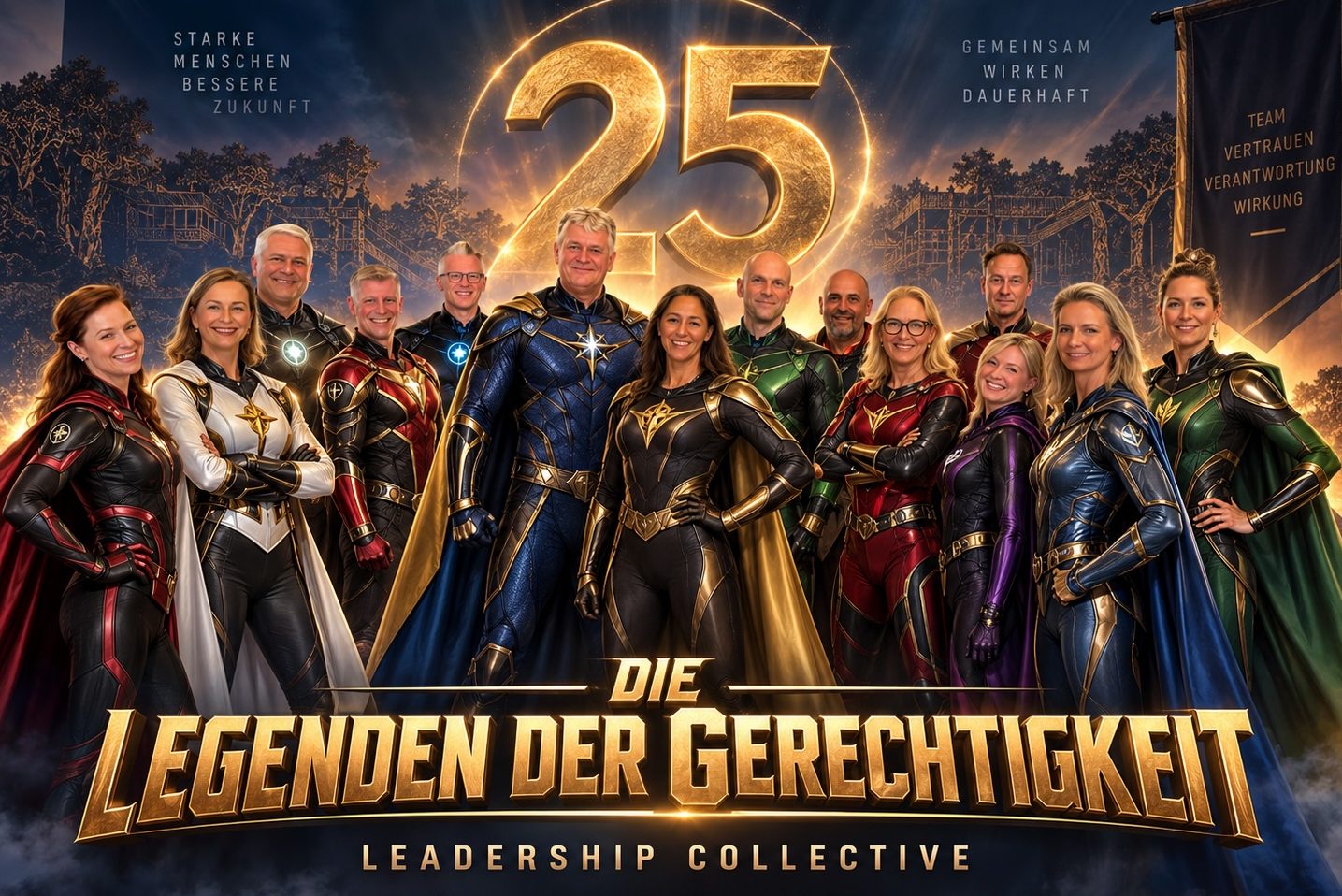



“What was the highlight of last weekend’s workshop for you?” I asked Wolfram a few days ago. At the end of August, to celebrate my 25th anniversary as a self-employed consultant and coach, I hosted a “Leadership Collective” workshop.
The idea emerged as the number of my one-on-one coaching sessions continued to grow. Quite often, one coachee struggles with a challenge for which another has already found an answer. That person’s experience could be tremendously valuable. I also often suspect that the two individuals would genuinely enjoy each other’s company. After all, I work only with people I personally find pleasant. A luxury, I know. What if they could connect directly? That was how the “Leadership Collective” concept was born.
- The idea was to bring together exceptional people who can set aside their egos and truly listen to others
- Create a setting for authentic, in-depth dialogue on an equal footing
- Reflect together and combine experiences to find answers to complex questions
- Laugh together and simply have a good time while exploring meaningful topics
- Last but not least, and perhaps a little selfishly, learn something myself
- Let the workshop content be guided by what participants consider most relevant and valuable in the moment
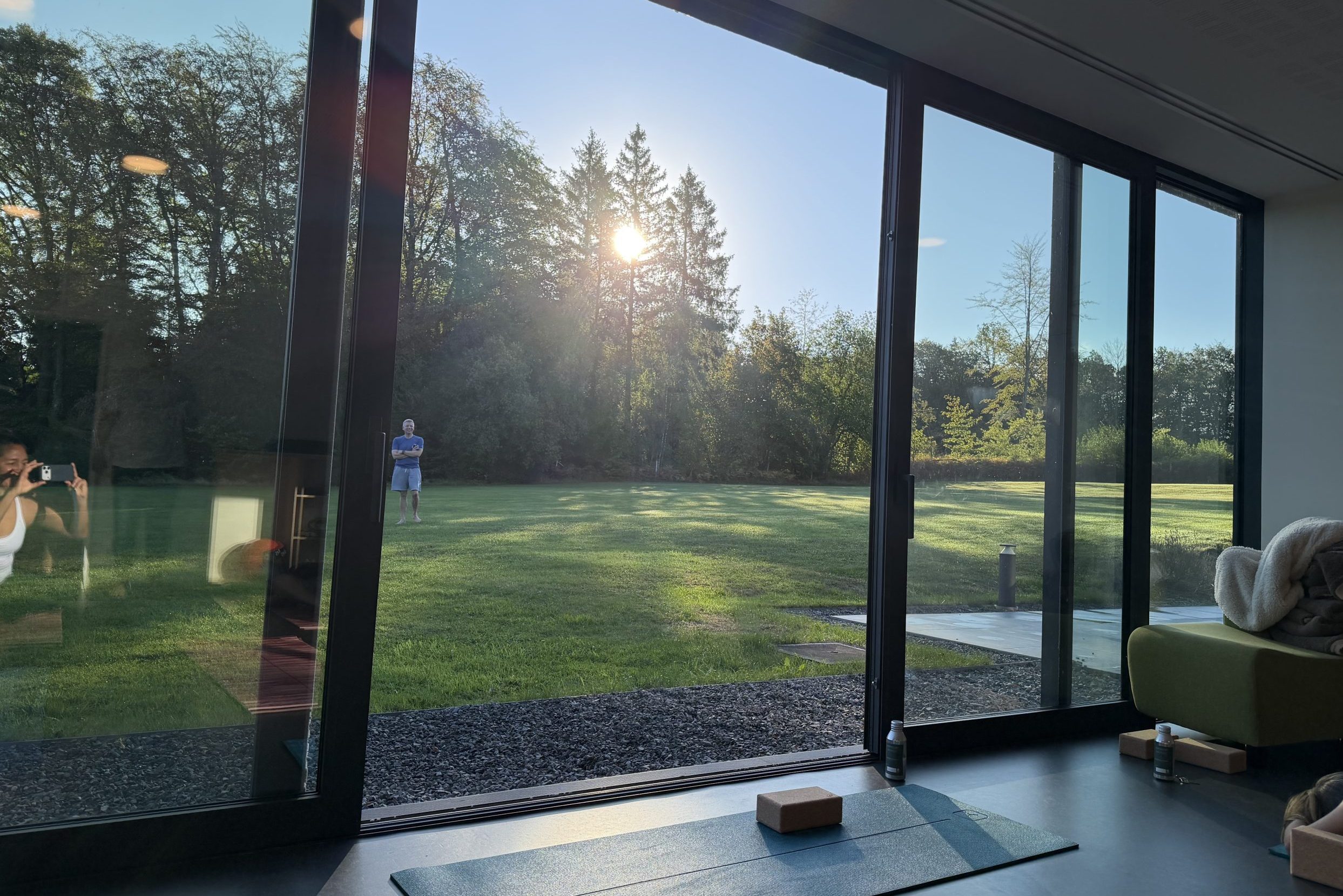
And that is exactly what happened. Twelve participants gathered at the enchanting Château du Haut-Neubois. The days were filled with yoga, Pilates (special thanks to Julia), running, excellent food, live music by the wonderful Holger Queck, stimulating conversations, meaningful human connections, and plenty of laughter.
What was Wolfram’s highlight? His answer came without hesitation: “Benjamin’s talk about justice!” A very good choice.
Just leadership: Why there are no simple answers
Benjamin’s impromptu presentation is a prime example of how the Leadership Collective works. During lunch, a discussion about justice emerged from the seemingly simple question of why one should play “Rock, Paper, Scissors” without adding the “Well” option. Benjamin explained that whether something is perceived as just or unjust usually depends on the criteria used to define justice. While preparing a seminar series on the topic of “Just Leadership,” he reviewed a wide range of academic literature and identified three central principles of justice: performance, need, and equality.
- Performance: In sports, victory typically goes to the person who performs best, for example, the athlete who runs the fastest, throws the farthest, or jumps the highest. We would consider it unjust if someone else were to receive the gold medal. The same principle applies in business. Those who perform better, work longer hours, bear greater responsibility, generate more revenue, and so on, generally earn more money. Of course, people can debate endlessly what constitutes the “right” way to measure such contributions. Furthermore, no business outcome can be attributed solely to the efforts or competencies of individual people. Sometimes luck plays a role. Or the absence of it. It is therefore no surprise that many employees feel unfairly treated during performance reviews. Yet I am not aware of any company that fundamentally questions the performance principle itself.
- Need: Health insurance works on the principle that everyone contributes, but only those who need assistance receive benefits, whether for surgery, hospitalization, medication, and so on. Someone may contribute large sums over a lifetime and never draw on those benefits. Many companies give parents priority when requesting vacation during school breaks because they need to arrange childcare. However, this often strikes some colleagues as unjust because they apply the third principle:
- Equality: Equal rights for everyone. This principle is also common in organizations. At one insurance company, every employee received a Christmas gift bag each year, regardless of rank or whether they worked part-time or full-time. Everyone received one. Incidentally, the color of the Christmas bag was also non-negotiable. The guardian of the corporate design insisted on maintaining the company’s “non-color palette”: various shades of gray were acceptable, Christmas red was not. Each bag contained a copy of the company’s annual special-edition novel, naturally with a gray cover, and a color-coordinated Christmas card. Additional festive items could be added. And that is where the real problems began. One person dislikes fruitcake altogether. Another loves fruitcake but absolutely not with marzipan, which others consider essential. Some people view alcohol as inappropriate. Others are delighted to receive a bottle of champagne they would never buy themselves. But should the Executive Board also receive one? At that salary level, surely they can buy their own champagne. Shouldn’t the person washing dishes in the office kitchen receive two bottles instead? Which brings us right back to the principle of need. Naturally, employee representatives were always involved in determining the contents of the Christmas bags to ensure an appropriate, if not just, solution. At one point, gourmet food store vouchers were suggested. Some employees then found those too impersonal.
What do we learn from this?
- Different principles can lead to solutions that people perceive as fair.
- The search for just solutions does not necessarily lead to inner peace. Not even at Christmas.
- Some companies struggle with problems that other organizations would gladly have.
- The human capacity for suffering is almost unlimited.
Not all of these examples were discussed during the workshop itself. Some occurred to me days later while swimming or walking to the office. Benjamin’s presentation stayed with me long after the workshop. To my surprise, it even helped me facilitate a conflict. It became much easier for me to stop searching for the perfectly just solution in my own head once I understood that both parties would likely perceive any solution as unjust because they were using different criteria to evaluate justice. The mental energy this realization freed up could then be directed toward calming tensions. Another lesson learned. Mission accomplished.
Shared experiences that continue to resonate
I continue to receive reflections from workshop participants:
- The ideas shared about managing high performers during a breakout session proved useful in my company.
- The experiences another participant shared regarding the sale of his company have been invaluable for my decision-making process.
- It helps to know I’m not the only person in a senior role who sometimes feels intellectually underchallenged. That realization makes me view my employer with much greater appreciation.
- It is wonderful that expertise I take for granted in my company is so highly valued by others.
- It was incredibly refreshing to take a deep breath together with like-minded people.
- …
I’m still thrilled by how these fascinating individuals came together as a collective for 48 hours, and by what I continue to hear long afterward.
To be continued
I never imagined that the Leadership Collective would work so exceptionally well. There will be a sequel in 2027, this time without a special anniversary. No one knows today which topics will be on the minds of these remarkable people then. But I am 100% certain of one thing: It will be a valuable experience together. On an equal footing, with depth, and a lot of fun.
And what was my personal highlight of the event? That’s difficult to say. Well, actually, one thing comes to mind: they had alpacas at Château du Haut-Neubois.