
“How do we get more women into leadership positions?” is a question that concerns nearly every organization. In many companies, women and men are represented equally at entry level, yet the higher you go up the hierarchy, the more that balance shifts. In Germany, women still hold fewer than 30% of top leadership positions. For decades, countless measures aimed at counteracting this have been put in place with little impact: quotas, mentoring initiatives, networks, among others. And yet, the ratio of women to men in top positions is improving frustratingly slowly.
The mysterious disappearance of women from the lineup
Things are even more extreme when it comes to surfing. In beginner classes, women make up over 50% of all participants. But as the waves become more demanding, women seem to disappear. Surfers tackling the more challenging waves are usually men. Now, here’s the thing: good waves are a scarce, highly competitive resource, much like top positions in business. To catch one, you have to assert yourself in the lineup. Why is it that women are less successful here than men?
- Do women not have the necessary competencies and skills?
- Is it due to a lack of ambition or a weaker competitive drive?
- Or is there a kind of glass ceiling in the ocean as well that women can’t break through?
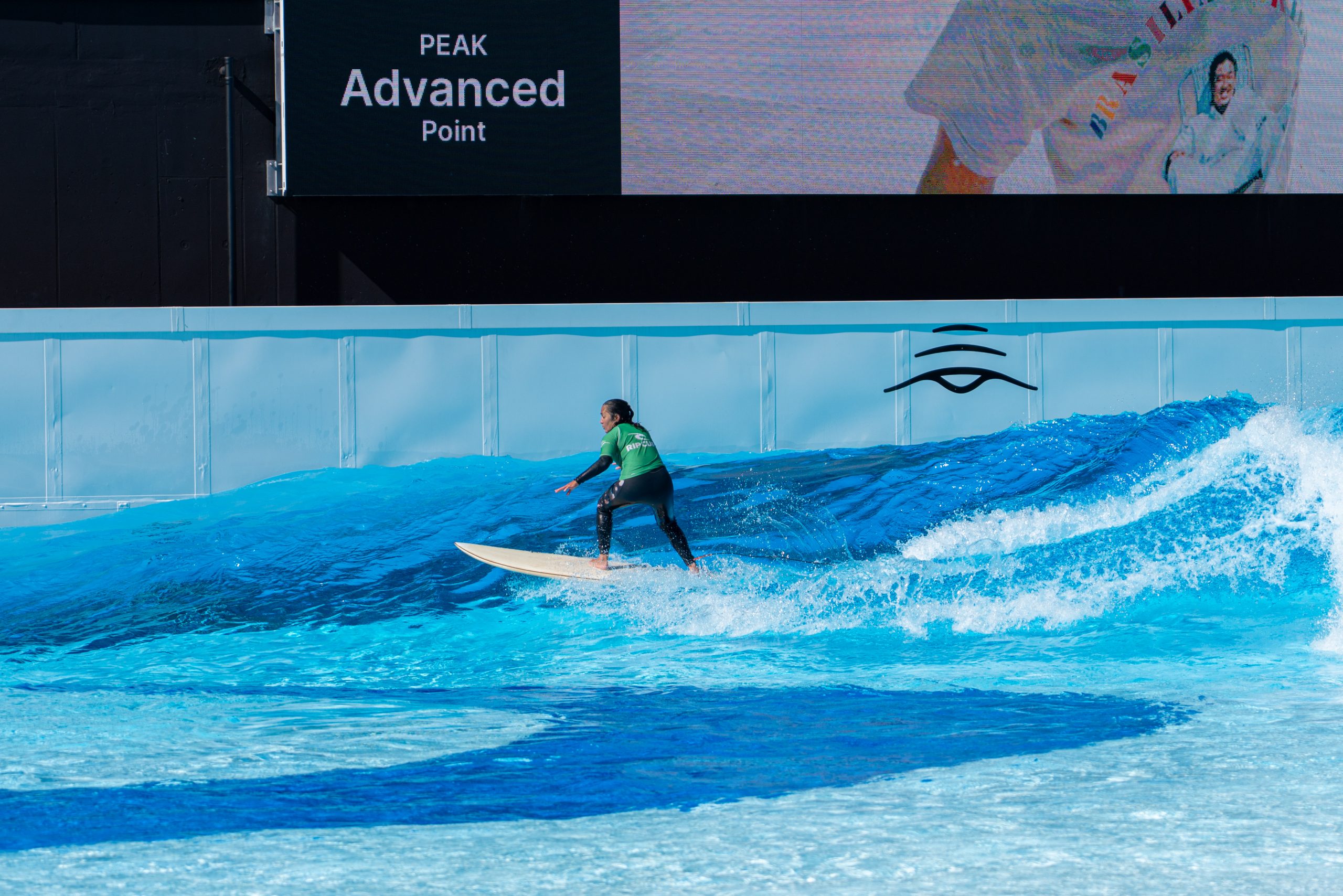
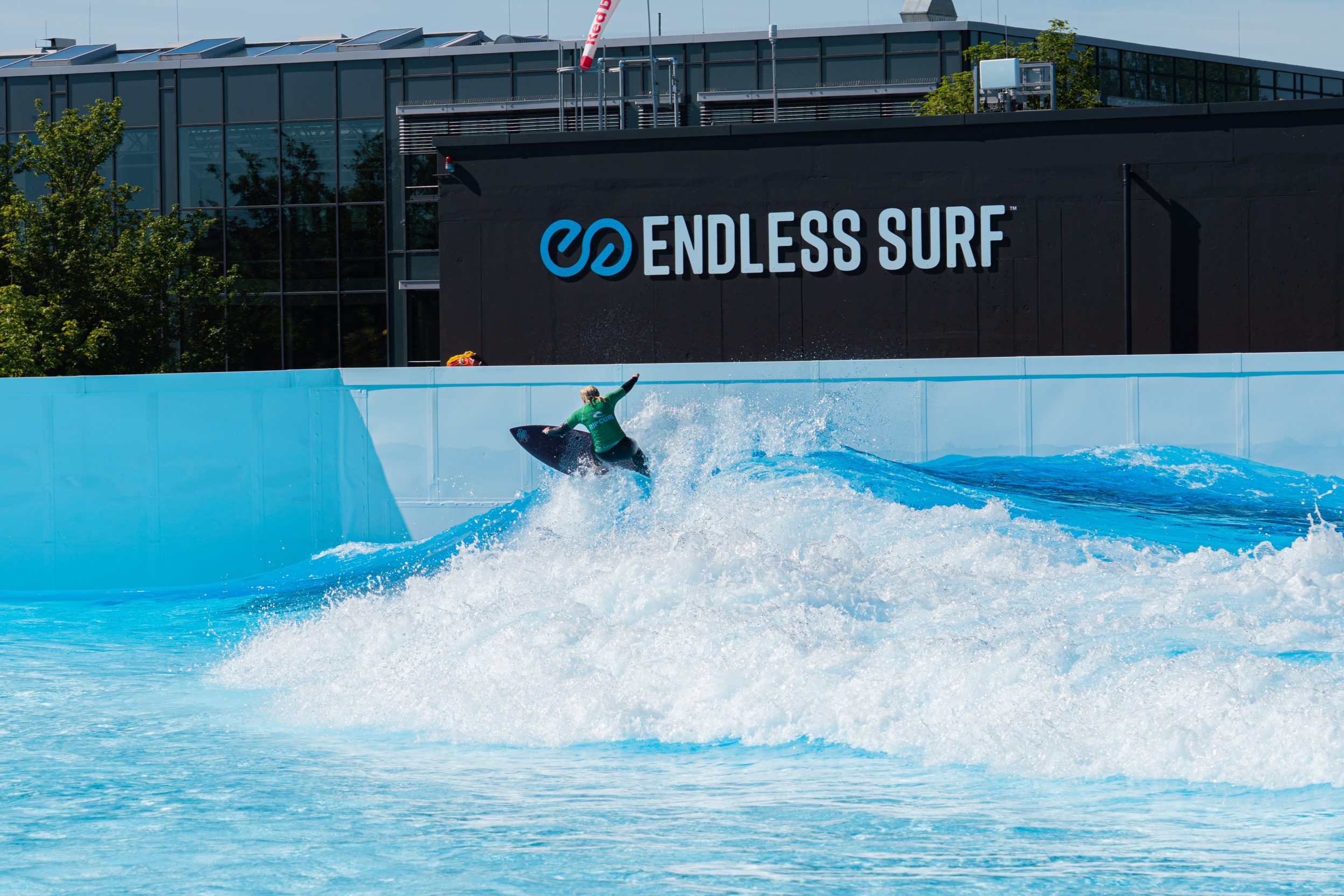
There are likely several causes, but what can actually be done about it? Quirin Rohleder, Head of Surf, and Linda Zinßer, Customer Service, at O2 Surftown MUC in Halbergmoos near Munich are committed to addressing the low number of women surfing more advanced waves. O2 Surftown MUC is the largest surf pool in Europe, an incredibly impressive facility where waves of varying difficulty levels can be created at the push of a button. That means children and adults can practice on beginner waves in dedicated sessions, while advanced surfers and professionals can challenge themselves with steeper waves and even barrels. It’s an incredibly fun place to surf – and the ideal environment for improving your skills.
Women-only sessions: community and safe space
In early May, my surfing buddy Sunshine Makarow and I visited O2 Surftown MUC, as she was writing an article for Wavepool Magazine on the topic of women and surfing. Starting this year, O2 Surftown MUC has been hosting monthly “Women-Only Sessions” for members. The idea is to build a community among women and create a space where they can surf free from the competitive energy that some men bring into the sport. The May session took place at the advanced level. Linda, who organizes the “Women-Only Sessions,” mentioned that this session, unlike the ones in April and June, did not sell out. Interestingly, the other two sessions were held at the intermediate level – one step below advanced.
“I’m not at that level yet”
So what’s going on here? Is there (still) a lack of experience among women surfers in Munich? Linda explained it like this: “We often see women surfing at the intermediate level who, in our view, are already ready for advanced. But they continue to book intermediate instead. Their reason is usually: ‘I’m not at that level yet,’ – even though our surf coaches see it differently, and they’re the experts! With men, we often see the opposite: some overestimate their skills and book waves that are too big for them. Even if they wipe out wave after wave, that doesn’t stop some of them from booking the same level again next time.”
That hits me like a bolt out of the blue, and made me think of Martina. Martina had spent years working as a manager in an industrial company. In several talent reviews, she had been identified as a potential candidate for a C-level position. Yet she herself wasn’t sure whether that kind of position was really right for her. Coaching was meant to help her gain clarity. At the same time, there was no immediate decision to be made, since the relevant positions at Martina’s company were already filled – by men!
Failure as a learning experience – let’s paddle out!
A few weeks after our coaching sessions began, Martina was approached by a headhunter about a top position at a competitor. She went through an audit process, but in the end another female candidate came out on top. Martina didn’t get the job. The experience only deepened her self-doubt. “I’m not at that level” became a recurring belief that steadily undermined her confidence. (Self-)doubt often keeps us from recklessly venturing into the unknown. Our ego uses it as a protective mechanism – to shield us from the shame or pain that failure can bring. To reinforce this fear, it pulls out old stories as supposed evidence. In Martina’s case, that meant failed math exams back in 11th grade. Our ego also conveniently ignores all the evidence suggesting that taking the next step might actually make sense. for example, the positive feedback Martina received from customers, colleagues, and even her CEO. This is how our ego holds us back. It isn’t always telling the truth. But as surfers say: you only know if you go.
So Martina and I worked on reframing failure as a learning experience. Not getting a job – or missing a wave – feels unpleasant, yes. But it won’t kill you. And it certainly doesn’t mean it won’t work out next time. Whether you’re navigating top-level hiring processes, convincing a Board of Directors, or landing any job in the world, the same rule applies: nobody starts out as an expert. Practice makes perfect, both in business and in surfing. So, let’s paddle out!
Trying approaches that don’t work
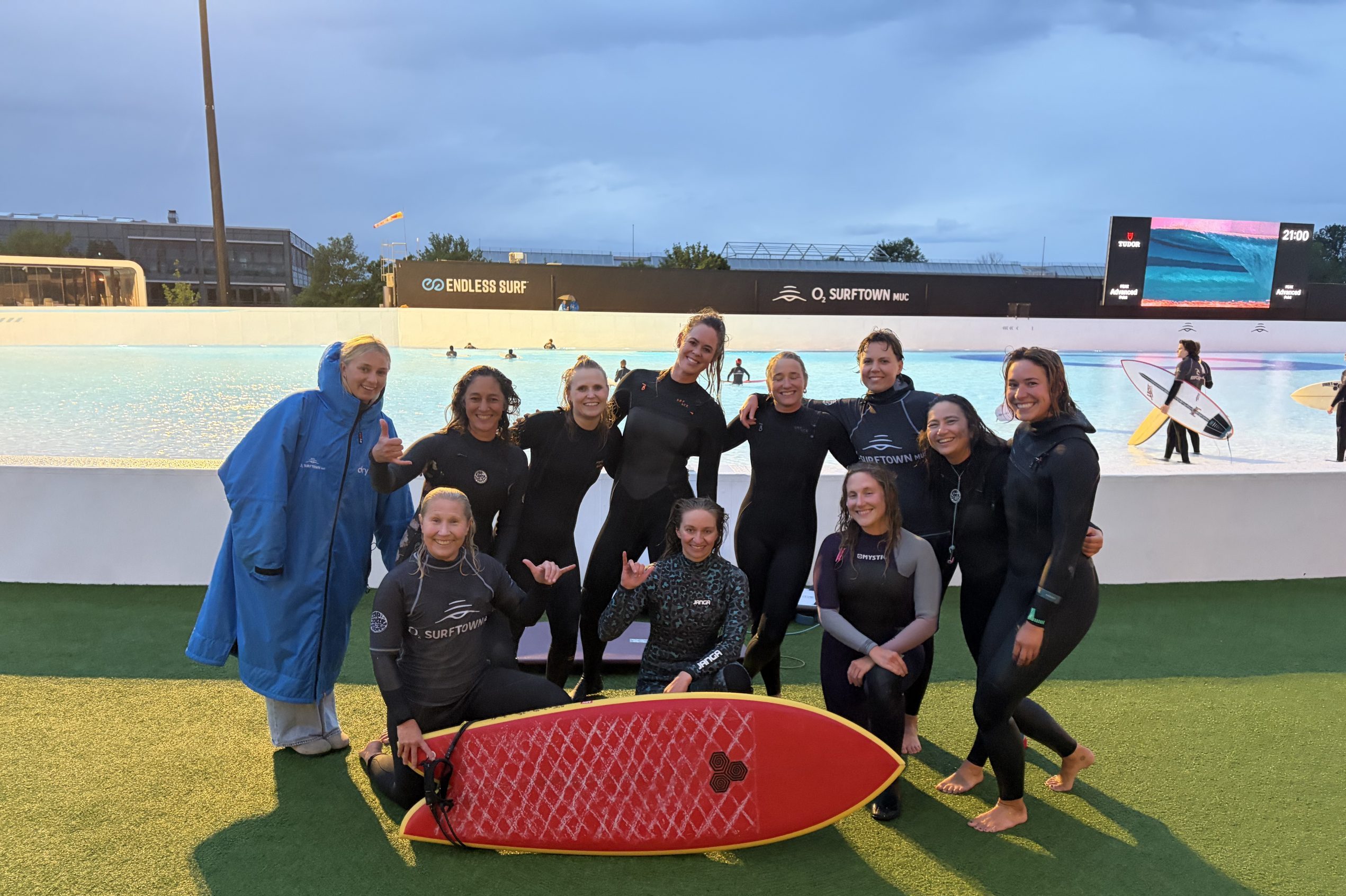
An hour before our “Women-Only Session,” we gather for a get-together. And by “we,” I mean a group of incredibly likeable, impressive women. Some have traveled the world honing their surfing skills. Others have spent years surfing Munich’s famous Eisbach wave – a wave that, after seven years of surfing in the ocean, I still don’t dare to try myself. You can probably guess why: “I’m not at that level yet!” ;-). Two of the women are trying the advanced wave for the first time. They’re a bit hesitant and nervous. “I’m sorry in advance if I don’t make it onto the wave and end up getting in the way,” one of them says in classic surfer style. And of course, when you try a new wave for the first time, there’s always a chance you won’t catch a single one. As my coach Matt Griggs puts it: “You haven’t failed; you’ve just tried different ways that don’t work.”
Stoked – A perfectly normal surf session
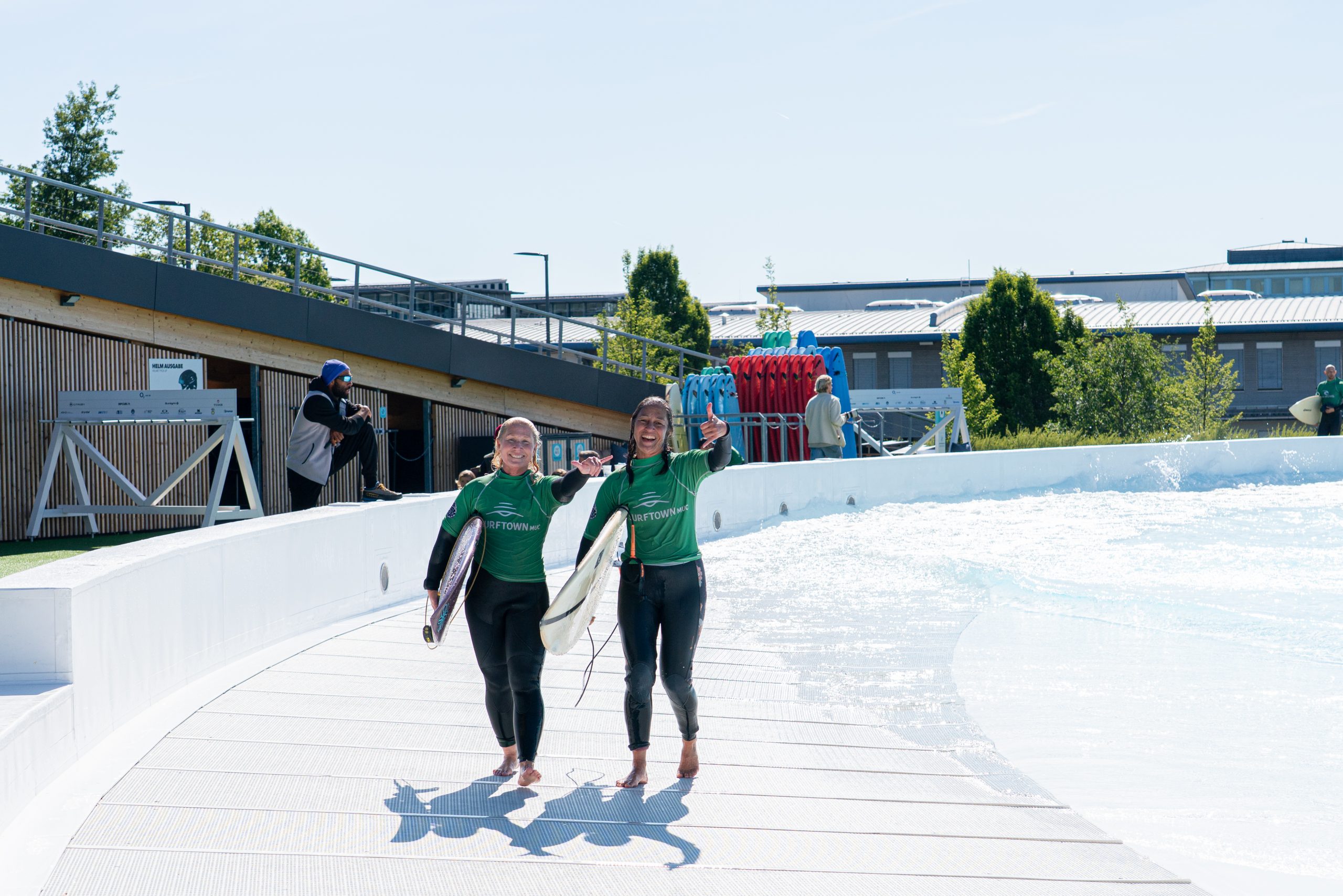
Then it was time to surf. What follows was a perfectly normal surf session. Just like me, every participant missed a wave or failed to surf it perfectly. But unlike the ocean, where every wave is different, a surf pool gives you the rare opportunity to ride the same wave again and again and refine your surfing technique. In this case, 16 times! Every surfer made some form of progress during the session, even if it was modest. From the outside, you couldn’t tell who had surfed that wave before and who was there for the first time. Once again, a familiar truth proved itself: 90 percent of the drama in our lives happens only in our heads. There was cheering and laughter. The atmosphere felt relaxed and euphoric. The famous “surfer’s stoke” kicked in. Was that the effect of an all-women session? Or is that simply what happens when people push through their doubts and do something that scares them?
By the way, Martina was recently offered a C-level position. It’s a demanding role, and yes, failure is always a possibility. But it also offers exactly what matters to her: meaningful work where she can truly make a difference, a strong team, and an extremely attractive salary. An audit confirmed that she has the necessary skills. She has the trust of the Board of Directors and her future colleagues. She has support from her personal circle. Yet, because of her self-doubt, she almost turned the opportunity down. Once again, she raised concerns I rarely hear from men, especially the fear that her relationship with her children might suffer because of her work. Really? How many men have allowed that question to stop their careers?
Different ways of dealing with doubt
How can we get more women into (top) leadership positions?
- Do men find it easier to ignore the doubts that arise in everyone in new situations (= beyond the comfort zone) and move forward?
- Do these same doubts make women in similar situations more likely to hesitate or say “no” to an opportunity?
- Does this cause companies to lose valuable female managers along the career ladder?
It would be nice if that were the case. Because then it could be changed by bringing self-doubt, worries, and fears out into the open and breaking them down step by step. I’m not sure whether special events for women are needed for this. What certainly doesn’t hurt is reminding yourself: If others believe that you’re ready for the next level, they might actually know what they’re talking about!
It’s your wave – go get it!
Photos: Rodrigo Soares